This paper proposes a model-theoretic characterization of the belief revision () operation discussed by AGM. Grove’s idea is to give a “spheres semantics” inspired by (Lewis, 1973a) for , thus enriching the purely syntactic approach by AGM.
Grove’s sets the stage without taking a stance on some (trivial) background assumptions, so I will fill in the gaps.
Let be the set of well-formed sentences in a Boolean language, and be the set of “logical theses of some logic”, i.e. let be the set of propositional tautologies and to be closed under modus ponens. Define:
- A theory is a subset of that is closed under modus ponens, i.e. .
- A set of formulas is consistent, , iff .
- The revision function satisfies the following axioms: for any and ,
- (+1) [this holds trivially],
- (+2) ,
- (+3) , if ,
- (+4) , if ,
- (+5) , if ,
- (+7) ,
- (+8) , if .
There are two objects that deserve extensive discussion: maximal consistent extensions of , and the function .
1. Maximal Consistent Extensions of
Grove does not take the notion of possible world as primitive, but he starts from syntactic objects (sentences) and then constructs other objects (maximal consistent sets of sentences) that are basically equivalent to possible worlds.
The set is the set of maximal consistent extensions of , and it consists of sets such that:
Maximal Consistent Extensions of the Logic
Let be a logic, where is the set of all well-formed formulae. Then, define as the set of consistent maximal extensions of the logic , that is
Note that, for any , is a theory.
Proposition
For any , is a theory.
bproof Consider and suppose for reductio that . Since by the Reflexivity of , implies that there is such that . Set . Clearly, we have and . Since , must be maximal, and hence , contradicting the consistency of . Therefore, . eproof
The following propositions clarifies why is a possible world. First, let me establish that could have been defined in a different, equivalent way.
Proposition
Let .
bproof () Take arbitrary and . Obviously, (1) and (2) hold. So, let me prove that (3) holds as well. We have two cases: either or .
- If we are done.
- Suppose that . Consider now . Since , by Monotonicity , and by Reflexivity . Since but , . By the maximality of , since , it must be the case that . Therefore, must be inconsistent, meaning . By the deduction theorem for classical logic, we have that . Since is classically equivalent to , we have that . Since is a theory (i.e., ), it follows that .
Therefore, either or .
() Suppose that, , , and that for all , either or . We need to prove that is a theory and that it is maximal.
- Let me first prove that is a theory. We need to prove that . () Obviously . () Let us show that, if , then . Suppose for reductio that and . By the completeness of , . Since , . Since , , contradicting the consistency of . Therefore, . Since is arbitrary, we have , proving that is a theory, i.e. .
- Let me now prove that is maximal. Suppose that and , namely and there exists some such that . By the completeness of , . Since , both and are in . Hence, . Therefore, is maximal.
Therefore, if has (1)-(3) it must be maximal, and so . eproof
Proposition
For any , there exists exactly one possible world such that .
bproof First, recall that a possible world is basically a function (a valuation) from the set of propositional variables that maps each to either (false) or (true). The satisfaction relation for any complex formula is defined recursively from this basis.
Consider now any .
Part 1: Existence. We must first construct a world from and show that it satisfies .
First, let us construct the world . We define a valuation based on the contents of . For any propositional variable :
- If , we define .
- If , we define . Note that, from ^03a961, we know that if , then . So this definition is complete.
Second, let us show that : We must show that this satisfies every formula in . We can prove by induction on the structure of any formula that .
- Base Case (Atoms): For any , . This holds by our definition of .
- Inductive Step (Negation): Assume . We show .
- (by definition of )
- (by inductive hypothesis)
- (by ^03a961).
- Inductive Step (Conjunction): Assume and .
- and (by definition of ).
- and (by inductive hypothesis)
- (since is a theory, it’s closed under conjunction)
(This holds for all other connectives as well.) Since holds for all , it follows that satisfies all and only the formulas in . Therefore, . This proves at least one such world exists.
Part 2: Uniqueness. We must now show that is the only such world. Assume there is another world (a different valuation) such that . To show , we only need to show that they agree on all propositional variables, i.e., for all . Let be an arbitrary propositional variable in .
- Case 1: .
- By our construction, .
- Since and , it must be that .
- By definition of , this means .
- Thus, .
- Case 2: .
- By our construction, .
- Since is maximal and , we know by ^03a961 .
- Since and , it must be that .
- By definition of , this means .
- Thus, .
Since and agree on all propositional variables, they are the same valuation, i.e., . Therefore, for any , there exists one and only one world that satisfies it. eproof
In other words, there exists a function such that such that . This function is also a bijection.
Proposition
For all there exists a unique such that .
bproof Consider an arbitrary .
Part 1: Existence. Construct the set as follows
Clearly, it follows that by construction—i.e., for all . Second, let me prove that is in .
- is a theory. Obviously , so consider an arbitrary and let me show that . Since , by the Soundness of classical propositional logic, . Since , . Therefore, by the definition of , . Since , we have that is a theory.
- is an extension of . For all , we have that is satisfied by any world in . So, for all . Hence, for by construction.
- is consistent. Suppose for reductio that is inconsistent, i.e. (for is a theory). Then, we have that , and hence , contradicting . Hence, is consistent.
- is maximal. Suppose for some . There must be some such that and . Since , it follows that , and hence by the definition of , . By the construction of , . Since , . Since , . Therefore, is maximal.
Concluding, for any there exists a set of formulas such that and is a maximal consistent extension of (i.e., ).
Part 2: Uniqueness. Suppose and with . Suppose (without loss of generality) that there exists some such that and (). By ^03a961, since , . Therefore, since and , we have and . By the definition of , it follows that and : contradiction. Therefore, . eproof
Before moving on, consider the following definition.
Def
Let be a theory. Define
In a way, is the set of possible worlds that make true.
2. Properties of
Define the following operation .
Let . Define the function such that:
Note that, if , then . For , but if the condition—i.e. —is (trivially) satisfied by any .
Properties of
Let .
- is a theory.
- (for all theories , assuming compactness).
- is consistent if and only if .
- .
- If , then .
- If , then .
Let be a collection of maximal and consistent extensions of .
(1) is a theory. () Obviously, by the Reflexivity of . () Let us show the other direction. Consider an arbitrary . Recall that .
- Since for every , by the Monotonicity of , we have for every .
- Since every is a theory (maximal consistent sets are closed), .
- Therefore, for every .
- Consequently, for all .
- Thus, .
(2) , if is a theory and we have compactness. By definition, and so . Clearly, if is inconsistent (i.e., ), it follows that there is no such that (if , and hence , contradicting the consistency of ). Hence, , so and ex hypothesi, proving our equality. So, suppose that is consistent.
() Suppose . Since for all , for all such . Therefore .
() Suppose . Thus, for all such that . Suppose for reductio that , for is a theory. Since is consistent ex hypothesi and , it follows that —if , it follows that , i.e. , and so . Now, to prove a contradiction, we need to show that there exists a set such that and such that is a maximal consistent extension of (which implies yet ). To do so, we need both Compactness and Zorn’s Lemma.
- First, define the collection of sets . Clearly, is a poset. Consider now an arbitrary chain , and let us show that has an upper bound in . Define . Clearly, for all . We need to prove that , i.e. that and . Since for all , and , it follows that . Suppose now for reductio that . By Compactness, there must be a finite subset such that . Since is finite and is a chain, there must be a set such that . By the Monotonicity of , , and so , contradicting the fact that . Therefore, , and so . Therefore, has an upper bound in . Since is an arbitrary chain in , we conclude that any such chain has an upper bound in .
- By Zorn’s Lemma, it follows that has at least one maximal element: let us call it . By definition of , and . We must show that is in . We have already established that is consistent. Note then that, since , , hence is an extension of . Ultimately, note that is maximal. If , for some , it must be the case that —if , then (since ), , contradicting the maximality of . Thus, . Moreover, we have that , for Therefore, . However, . Since is consistent, . This contradicts the hypothesis that (which requires to be in every ). Therefore, we conclude that .
- Since is an arbitrary formula in , we have that .
We conclude that .
(3) is consistent iff is nonempty. () If , by definition we have that , and hence . Suppose that is inconsistent, meaning that . Since , where , it clearly follows that for all . If there is at least one , by the monotonicity of , , implying that . However, this contradicts the consistency of , thus there exists no , meaning .
(4) . We distinguish three cases based on the status of the set .
Case 1: . In this case, the intersection . By definition, (the inconsistent theory).
- LHS: .
- RHS: . The equality holds trivially.
Case 2: , but . In this case, the intersection is empty, so the LHS is . For the RHS, note that since , it follows that for all , , i.e., . Since every is complete, for all . Consequently, . Therefore, the set contains both and , making it inconsistent. Thus . The equality holds.
Case 3: . This is the principal case. Let us prove the equality by mutual inclusion.
() Let .
- We prove that . Suppose for reductio that . Since , there must exist some such that .
- Since is complete, . This is classically equivalent to , which implies and .
- Since and , it follows that .
- However, by our initial hypothesis, , which implies for all . Therefore, . We now have and , contradicting the consistency of .
- Therefore, the assumption was false, and . By Modus Ponens, contains .
() Let .
- By the deduction theorem (or definition of consequence), , which implies .
- Since is a theory, . By definition of , for all , .
- Consider now any . For such , we have and .
- Since and , it follows by closure of that .
- Since is in every , .
(5) For , if , then . Let and suppose . By definition, , which is the set of all formulae such that for all . Consider any . By definition, is contained in every world in . Since , every world is also a world in . Therefore, must be contained in every world . Consequently, . Since was arbitrary, . This relates to the general set-theoretic property that (Reverse-Inclusion Property).
(6) For , if then . Let and suppose . Consider any , that is any such that . Clearly, , hence , so . So, .
The proof is complete. eproof
3. Systems of Spheres
Systems of Spheres
Let be a collection of subsets of , i.e. . is a system of spheres centered on () for some subset , if it satisfies the following conditions:
- (S1: Nestedness) is totally ordered by : if , then or .
- (S2: Centering) is the -minimum of : and, for all , .
- (S3: ?) .
- (S4: Limit Assumption) If and for some , then there exists a sphere such that: (1) , and (2) implies for all .
The main differences between ^0e19fa and ^93cc74 are the following:
- Grove’s systems of spheres are not required to be closed under nonempty intersections and finite unions.
- More significantly, Grove’s systems of spheres are not centered on single worlds, but on sets of “worlds”.
We have that, for any ,
- If , then S4 ensures that there exists some sphere in , call it , which intersects and is smaller than any other sphere with this property.
- If , then S3 implies that , and we take .
Thus, given a sphere system , we can define a function such that
(N.b. recall that is a sphere.) In other words, selects the closes worlds in to where holds. Note that S4 (the Limit Assumption) plays a crucial role here, for it ensures that is nonempty when is not inconsistent (i.e., ).
Grove proposes a different kind of model, which he claims to be equivalent to ^0e19fa.
Total Order on
Let and ( for simplicity) be a relation on satisfying the following:
- () is connected: for all , either or .
- () is transitive.
- () If , then the set – this is the analogue of S4.
- () is -minimal (i.e., for all ) if, and only if, .
Proposition
bproof TBD eproof
Before introducing the main proofs by Grove, consider the following useful lemma.
Lemma
Let .
bproof The proof is straightforward.
- Note that is the set of such that . Since is a theory ^9d8d32, , so . The other direction follows analogously.
- Note that is the set of such that . Since is a theory ^9d8d32, either or , so . The other direction follows analogously.
This completes the proof. eproof
Augmentation (“ ”) vs. Revision (“”)
In ^19b236, . It is useful to see what augmentation amounts to in terms of spheres system. First, by ^243d0b, for any and ,
Therefore, by properties (2) and (4) in ^243d0b,
So, while revising a theory by means taking , where is a system centered on , expanding a theory by means taking . (N.b., if , it follows that , as expected.)
4. Soundness and Completeness
The following two theorems are the main result of (Grove, 1988).
4.1. Soundness
Soundness
Let be a system of spheres in centered on for some theory . If we define, for any ,
then the axioms (+2) to (+8) are all satisfied.
bproof Let be a system of spheres in centered on for some theory .
(+1) Clearly, , for is a theory for any by ^243d0b, and .
(+2) Let me prove that . We have by definition. Since is a sphere, it is a set of . By ^243d0b (prop. 4), it follows that
and since , .
(+3) Suppose , and let me prove that . Since , it follows that is consistent, i.e. there exists some such that and . Therefore, . Since is the smallest sphere in and , it follows that . So,
and since , it follows from ^243d0b (prop. 4)
(+4) Suppose , and let me show that , i.e. that . Let me show that , and conclude from ^243d0b (prop. 3).
Since , is not a contradiction, therefore there exists some such that . So is nonempty. Since we also have that is nonempty, by S4 is nonempty, and it is the smallest such that is nonempty. Hence, is nonempty, and by ^243d0b (prop. 3), is consistent.
(+5) Suppose , and let me show that . Since , for all , we have that : if , since is a theory and , , and the same goes for any . Since , , and therefore , which implies that
(+7) We need to prove . First, note that by ^f62804, . This means that any sphere intersecting does intersect as well. Consider now , i.e. the sphere such that (1) , and (2) for all with . Since intersects by definition, from the reasoning above it follows that it does intersect as well. By the definition of , then .
For any : .
is a sphere such that: and, for all , . Consider now . Since by definition, . By the definition of , it follows that .
Here is a graph showing why this is the case:
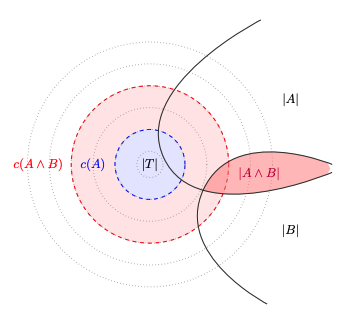
Therefore,
By prop. 5 of ^243d0b (i.e., the Reverse-Inclusion Property), it follows that
By definition, . Regarding the RHS, apply prop. 4 of ^243d0b by setting , and so
Therefore, we conclude that .
(+8) Suppose . We need to prove . Since and is a theory—see the proof of (+1)—it follows that is consistent with the theory , i.e. there exists at least one possible world such that and . Hence . We need to prove that also the “generating set” of , i.e. , is consistent with , i.e. that .
Suppose for reductio that . So, for any , . Since is complete for all , it follows that for all . Thus, , contradicting our hypothesis. Therefore,
Therefore, the closest sphere intersecting also intersects , and so by the definition of , it follows that . [Also, consider that the definition of and ^f62804 imply that . Therefore, .]
We then argue as above:
By definition, . Regarding the LHS, apply prop. 4 of ^243d0b by setting , and so
Therefore, we conclude that .
So, we have proved that, if , then satisfies (+1)-(+8). eproof
4.2. Completeness
Completeness
Let be any function satisfying (+1)-(+8). Then, for any fixed theory , there is a system of spheres on , , centered on and satisfying for all .
bproof Let be any function satisfying (+1)-(+8). Consider an arbitrary theory . Define as the class of all nonempty subsets satisfying the following conditions:
- (Relevance) For all there is such that , and
- (Swallowing) For all , if , then .
Then, define as follows:
(In other words, the candidate sphere system is obtained by adding the universe (and possibly the empty set) to .) Let me now prove that is a system of spheres.
Part One: is a system of spheres.
(S1) Distinguish two cases.
Case 1: is inconsistent. By construction, . Let .
- If or : Since for any set , the nesting condition ( or ) holds trivially.
- If or : Since for any set of worlds , nesting holds trivially.
- If : These are nonempty sets satisfying Relevance and Swallowing. The proof is identical to Case 2 below. (Note: In step 6, the non-emptiness of is guaranteed by axiom (+4) solely because is consistent. it does not require to be consistent).
Case 2: T is consistent. Let . Suppose for reductio that and . This means there exist worlds and .
- Since , by (Relevance) there is some such that . By (+2), , hence for all , —that is, . So, . Since , the intersection is not empty, and by (Swallowing) we have .
- Since and , it follows that .
- By the contrapositive of Swallowing for : If , then .
- Analogously for : There exists such that . Since , . By Swallowing for , .
- Consider now .
- . Since , . By Swallowing, .
- . Since , . By Swallowing, .
- Therefore, .
- By (+4), since is consistent ex hypothesi, is consistent (unless is logically false, which is impossible since ), so . Let .
- and .
- Also, since by (+2), we have , so or .
- If : since , . Contradiction with (3).
- If : since , . Contradiction with (4).
- Either way, we get a contradiction. So, our initial assumption was false. is nested.
(S2) Let me show tha (1) and that, (2) for all , .
(1) To prove that , distinguish two cases.
(1.1) If is inconsistent, i.e. , then , and by construction of for the inconsistent case, . Moreover, is hence a -minimum for in this case, for for any set .
So, suppose is consistent.
- (Relevance) Let me show that Relevance holds for . Consider now an arbitrary and an arbitrary tautology in , which I will call . Since is consistent ex hypothesi, , hence by (+3) it follows that . Since , , for is a theory ex hypothesi. Therefore, it immediately follows that .
- (Swallowing) Consider an arbitrary and suppose . That is, there exists a possible world such that and . Therefore, (otherwise, , contradicting the consistency of ). By (+3) . This implies that [see callout below]. Therefore, we have that , proving that satisfies (Swallowing).
If ,
(Note: This assumes the case where , so .)
() Suppose is such that . This means . Since and , it follows that and . Therefore, and , so .
() Suppose is such that . From the latter, and , which implies . By Monotonicity for , . Since is a world (maximal consistent set), . Thus, , meaning . Since ex hypothesi, , hence .
Concluding, .
Therefore, , and so . Consider now any , and let me show that . First, note that either or , which implies that is nonempty.
- . Since , and is nonempty, we have that . By (Swallowing), . Since is consistent ex hypothesi, , hence by (+3) it follows that . Since , , for is a theory ex hypothesi. Therefore, , and so . Since is arbitrary, is a -minimum.
- . Obviously, .
Thus, (S2) holds.
(S3) by construction.
(S4) We must prove: If (i.e., if is consistent), then there exists a sphere such that:
- (It intersects ).
- For any , if , then (It is the smallest such sphere).
Assume (i.e., is consistent). We construct the specific set as defined by Grove.
(In words: The union of all revisions by where is logically weaker than ).
- Prove (1). Naturally, holds. Therefore, is one of the sets included in the union . Since , (note that , for all ). By postulate (+4), is consistent, so . By postulate (+2), , and so . Since , , and , then
- Prove (2a). We must show , i.e. that it satisfies the two conditions for : Relevance and Swallowing.
-
(Relevance). By definition, is a union of sets of the form . Therefore, every world belongs to some .
-
(Swallowing) We need to prove that, for all , if , then . Suppose . By the definition of , this implies that there is some such that (i) and (ii) .
Consider the sentence . Note that . Therefore, by the definition of , is part of the union , so . We now claim that . Suppose for reductio that . This implies that, for all worlds such that , , and hence . Since is a theory, . Since is consistent by (+4), it cannot imply . Since it implies , it must be that (otherwise it would imply both negations, and thus the negation of the disjunction). Since , we can apply (+7) and (+8) to establish:
Since is logically equivalent to , the LHS is . If (as assumed), then must also be in the expansion on the RHS. Therefore, . But this means (for any is consistent), contradicting assumption (ii) above.
Therefore, , which implies . We can now apply (+8):
We now translate this syntactic inclusion into semantic set inclusion. Recall that if theory , then .
Since we established earlier that , it follows by transitivity that . Thus, Swallowing holds.
-
Step
The step denoted by relies on a crucial relationship between syntactic expansion and semantic intersection of truth-sets. The following provides justification for why (where is the theory ).
First, note that the following holds:
obviously holds: since and , if , clearly and . suppose now that and . Since ex hypothesi, by Monotonicity , for is a theory. Hence, .
Moreover, the following is clearly true:
For
- is the definition of .
- is the definition of .
Combining the two iffs, we get , which means that:
N.b. Don’t forget that returns different value, depending on whether its argument is a formula of a set of formulas !
-
Prove (2b). We need to prove is the Smallest Sphere (Minimality). Let be any sphere in such that . We must show . Take any component that makes up (where ). Since and , it follows that .
Since is a sphere in , it must satisfy the Swallowing condition. Because intersects , by (Swallowing) . Since this holds for every such that , the entire union is contained in :
We have constructed a set that is a valid sphere in , intersects , and is a subset of every other sphere intersecting . Thus, Condition (S4) holds.
Part Two: .
We need to verify that the system of spheres we constructed actually generates the original revision function . Specifically, we want to prove:
We will prove the stronger condition that the sets of worlds are identical:
Case 1: is Inconsistent ().
- By Postulate (+2), . If is logically false, then contains a contradiction, so (the inconsistent theory). Thus, .
- On the sphere side, if is inconsistent, . Therefore, .
- The equality holds: .
Case 2: is Consistent (). We prove the equality by mutual inclusion.
Direction 1:
- Since is consistent, by Postulate (+4), is consistent, so . Also, implies .
- Recall that is the smallest sphere in intersecting . Since and , we know , so exists.
- Since is a sphere in our system , it must satisfy the Swallowing condition, i.e. if , then .
- Since is the smallest sphere intersecting , the antecedent is true. Therefore, .
- Combining this with , we get:
Direction 2: . This relies on the specific sphere constructed in Part One. Recall .
-
Minimality: In Part One, we proved that is a sphere intersecting and that for any sphere intersecting , . By definition, is the smallest sphere intersecting . Therefore, . (Note: In fact, , but inclusion is sufficient here).
-
Intersecting: Since , intersecting both sides with preserves the subset relation:
-
Collapsing the Union: We now evaluate .
Consider any term in this union (where ). If the intersection is empty, it contributes nothing. If the intersection is non-empty (), then . We can apply postulates (+7) and (+8):
In terms of worlds: . Therefore, every non-empty component of the union is exactly equal to . Thus:
- Conclusion: Substituting this back into step 2:
Concluding, since we have proved both and , we have:
Since is a theory, by ^243d0b (prop.2) applying the theory operator to both sides yields:
eproof
5. Alternative Modeling
Grove presents an alternative method for modeling a belief revision operation using a relation on the set of formulas . This modeling is advantageous because the axioms for revision do not uniquely determine the specific changes required; generally, there are multiple valid choices for upon revision by . Consequently, it is natural to consider an ordering of sentences to facilitate decisions regarding which elements to remove from or add to .
Plausibility Relation ( )
Consider the relation satisfying the following properties:
- is connected.
- is transitive.
- If , then or .
- is -minimal in if and only if .
- is -maximal in if and only if .
The expression is interpreted as “ is at least as plausible as ”.
Observations regarding these axioms:
- Axiom (3) implies that if , then . This follows from the equivalence of with , and the fact that “” is equivalent to .
- Axiom (4) assigns the minimal position to any sentence that is either in or consistent with (assuming is a consistent theory). Since revision based on functions by selecting the sentences that are “most plausible” given , it is reasonable to assign a privileged position to such sentences. These instances do not require actual revision (removing information from ), but rather augmentation (adding information without loss).
To prove that this is indeed an alternative modeling of , Grove shows that this relation is equivalent to a system of spheres centered on .
Lemma
Consider a system of spheres centered on , and define the following relation on :
and let us stipulate that iff . It follows that:
- satisfies axioms (1)-(5);
- the following definition of revision is identical to the one determined by :
bproof Part One. Let me first prove that satisfies axioms (1)-(5) of ^7efc5a.
- . Connectivity follows from the fact that is nested, while transitivity follows from the properties of .
- (). Suppose . Since , we have that (if , since and is a theory, , and since is consistent either or ). We have to show that either or .
- First, consider consider , namely the sphere in that intersects and such that, for any other sphere intersecting , . Consider . By definition, , and since , we have . By definition, it follows .
- Now, we observe that or . Note that , so any sphere intersecting intersects , implying . Similarly .
- Since intersects , it must intersect at least one of them. If it intersects , then by definition of , . Combined with the above, , so . If it intersects , then , so .
- Minimality (): is minimal iff for all . This holds iff is the smallest sphere in , which is (by S2). iff , which is equivalent to .
- Maximality (): is maximal iff for all . This holds iff is the largest sphere, (by S3). By convention, iff , i.e., .
Part Two. Define as follows:
T+A := \{ B\in F: A \land B <_{S} A \land \neg B \} \tag{\dagger}
We show that this set is equal to . () Consider any . By definition:
Suppose for reductio that . This means there exists some world such that . Since is complete, , and so . Since intersects (at ), it follows that . Also, note that by definition, intersects , and since , it intersects . Thus . Combining these inclusions: . However, ex hypothesi, . This implies a contradiction ( and is impossible). Therefore, .
() Let . By definition, for all , and so . This implies that contains no worlds where is true and is false. Equivalently:
Suppose for reductio that . This means . Since is connected, this implies , or:
Now we observe the relationship with . Since intersects , it must intersect either or (that is, since there is at least one , either of ). We established above that . Therefore, must intersect . Since is the smallest sphere intersecting , it follows that . Combining these facts:
This chain implies equality: . However, by definition, must intersect . If they are equal, must intersect . But we established at the start that : contradiction.
Therefore:
completing our proof. eproof
Corollary
The belief revision operator defined via the relation satisfies the AGM postulates (+1)–(+8).
bproof This result is an immediate consequence of Lemma ^448b11 and Theorem ^19b236.
- Lemma ^448b11 establishes that the revision operator defined by the relation (i.e., ) is identical to the operator defined by the system of spheres (i.e., ).
- Theorem ^19b236 establishes that the operator defined by the system of spheres satisfies postulates (+1)–(+8).
Therefore, by transitivity, the operator defined via satisfies the postulates. eproof
Representation by Ordering on Formulas
Let be any function satisfying (+1)-(+8). Then for any (fixed) theory there is a relation on such that, for all :
bproof This result follows from combining the representation of by spheres (Theorem 2) with the equivalence between spheres and formula orderings.
Since satisfies postulates (+1)-(+8), by Theorem 2 ^f347f9, there exists a system of spheres centered on such that for all , . Given this system , we define the relation on as:
and iff . By Lemma ^448b11, the revision operator determined by this relation is identical to the one determined by the system of spheres . Specifically:
Substituting the identity from step 1 into step 3, we obtain . eproof
Soundness of Ordering-Based Revision
Let be any relation on satisfying postulates to . Then the revision operation defined by:
satisfies the AGM axioms (+1) to (+8).
bproof Strategy: We prove this by constructing a system of spheres from the relation and showing they determine the same revision. Since sphere-based revision satisfies the axioms ^19b236, the relation-based revision must as well. eproof